 Competitions
 Deals & Bargains
 Personal Finance
 Thrifty Baby
 Thrifty Beauty
 Thrifty Christmas
 Thrifty Fashion
 Thrifty Food
 Thrifty Holidays
 Thrifty Home
 Thrifty Homebody
 Thrifty Outings
 Thrifty Planet
 Thrifty Wedding
Miss Thrifty14 October 6, 2009
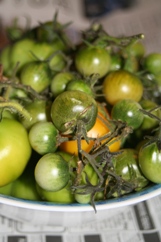 It’s getting nippy, isn’t it? The tomato plants in our back garden were still laden with unripened fruit, and I didn’t want to waste it. So this evening I went outside and picked it all in (left). This year we have giant Moneymakers, cherry tomatoes, cherry plum tomatoes, Gardener’s Delight and yellow tomatoes. The cherry and cherry plum tomatoes came from the plant bargain bin at the local garden centre; the others were grown from seed by Frugal Grandma and given to us when they were a few centimetres high. The plant pots were scavenged and the compost came from the Morrisons value range. All in all, if you don’t count the water, the summer’s bumper crop has cost less than £1. I’m happy with that!
Although they didn’t have time to ripen before the colder weather came crashing in (thank you, British Summer), I’m rather proud of this year’s crop. Last year was a disaster: the plants went into the vegetable patch at the back of the garden, grew big and strong, sprouted tomatoes and then… the tomatoes all went bruised and watery on the vine before they were ripe. I don’t know the whats or the whys – none of the pictures of diseased tomatoes on t’interweb matched – but I guessed that it must have been something to do with the garden soil. (As previously noted, my garden isn’t exactly problem-free.) So this year the tomato plants all went into patio pots, and they were fine.
I already have a backup plan for next year. It’s this unassuming sliver of a book.
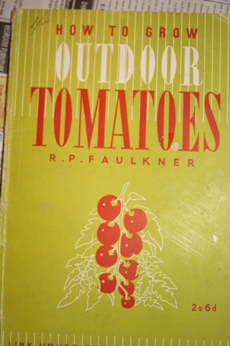
How To Grow Outdoor Tomatoes by R.P. Faulkner was published in 1949, when everyone was making do and mending, and rationing was still in force in the UK. The book must have been passed down the family; I picked it up at my mum’s house, idly, wondering how it was possible to produce an entire book on the subject. Well, now I know! And let me tell you now: next year, this little tome is going to be tucked under my arm as I produce sufficient tomatoes to feed all of North Yorkshire. I feel a future series coming on…
Take the pots, for example. This year, I filled them with compost and plopped the plants in. I don’t think that tomato fiend R.P. Faulkner would have approved, if the following counsel is anything to go by:
Into the bottom of the receptacle should go half an inch or so of broken pots or small pebbles with larger ones over the drainage holes to prevent the soil washing out, then a layer of coarse fibre from the loam to cover the drainage material and finally 1 1/2 inches of compost made by mixing 2 parts good medium loam, 1 part horticultural peat and 1 part coarse silver sand. Pass these through a 1/4 inch mesh sieve and to each bushel of the mixture add 1 1/2 oz Superphosphate and 3/4 oz Hydrated Lime.
Timesaving tip:
If the reader can come to friendly terms with a local nurseryman or, perhaps, the parks superintendent, to secure a supply [of good compost], the better growth will repay him.
I have never seen this city’s park superintendent – the flowers in the beds always look pretty and are suddenly there, as if by magic – but perhaps I should endeavour to track him/her down. Hmmm.
I was also tickled by this picture:
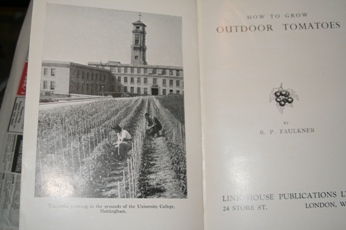
This is University College, Nottingham (now Nottingham University) in the 1940s. Evidently, the institution’s fine grounds have been turned into some sort of tomato metropolis. Bright young frugallers, kneeling in straight-cut slacks and rolled-up shirt sleeves, are overseeing things. Something tells me that Nottingham University’s grounds no longer look like this. What a shame.
Anyway.
In the book a couple of pages are given over to the ripening of green tomatoes.
The best results have been obtained by packing the fruit in layers in boxes, each layer being separated by a sheet of clean newspaper. The boxes should not contain more than five layers. An equable temperature of about 60 degrees fahrenheit is most conducive to steady ripening; violent fluctuations or extremes of heat and cold are generally unfavourable. If it is desired to keep some of the fruits for as long as possible the most perfect specimens should be chosen and packed separately, each fruit being placed in a small compartment to itself by partitions formed from paper and the container placed in a cool cellar. No guarantee can, however, be given of the success of this procedure and the prudent housewife will wiser to depend on her winter tomato supplies on preserving a proportion when they are plentiful in early autumn.
The fruits in store should be examined at intervals to make sure that all is well with them.
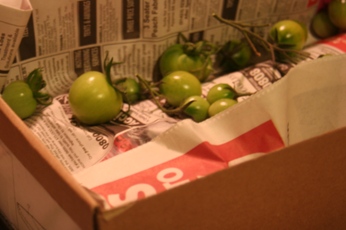
So this is what I have done. I have sorted my green tomatoes into this old shoebox, then removed the calyxes (the green star at each tomato’s “eye”) and packed them away. Don’t let me forget about them!
14 Responses to “Ripening green tomatoes, the 1940s way.”
Tamsin says:
Amazing photo of the uni there – I went to Notts uni, and still live in Nottingham. Don’t suppose you have a bigger picture of the pic? My boyfriend (who is still there doing his PhD) would love to send it to the allotment society there! x
October 6, 2009 at 9:17 pm
Tamsin says:
Similar angle of the University now: http://www.natures-desktop.com/images/Wallpaper/Fullsize1280/Man-Made/University-Park-Nottingham.jpg
October 6, 2009 at 9:19 pm
admin says:
@Tamsin
Leave it with me, Tamsin – I’ll scan it in and send a copy over to you. 🙂
– Miss T
October 6, 2009 at 9:36 pm
Claire says:
the best thing to do with Green Tomatoes is to make green tomato chutney. It’s sensational.
Mine all ripened this year which means no chutney, which is weirdly disappointing.
Do let me know if you would like the recipe.
October 7, 2009 at 9:21 am
Clare Flynn says:
What a great book – these old ones always give such simple and straightforward advice – like Frugal Grandma!
You might also just try putting your green tomatoes in a fruit bowl with some apples – that usually does the trick for me.and that way there’s no chance you’ll forget them.
On the other hand if you want some things to do with them when they are green – we have quite a few ideas on our website – http://www.makeitandmendit.com/2009/09/09/italian-recipes-for-green-tomatoes-under-oil-or-under-vinegar/
I also noticed Nigel Slater last night did a dish with tomatoes fried with some bits of lavender topped off with goats cheese – ane several of the toms he was frying were green ones.
October 8, 2009 at 4:47 pm
admin says:
@Claire
Recipe? Yes please!
@Clare
Great pointers – thanks very much.
– Miss T
October 9, 2009 at 11:47 pm
Claire says:
Hi Miss Thrifty, here is the recipe for green tomato chutney. It’s an old one, hence the imperial measurements!!
2lb green tomatoes chopped
8oz onions finely chopped
8oz cooking apples peeled and chopped
2 small fresh red chillies
2 teaspoons chopped fresh ginger
1 1/4 cups brown sugar
1 cup chopped raisins
1 teaspoon cinnamon
1 1/2 teaspoons salt
1 1/4 cups malt vinegar
– put tomatoes, onions and apples in saucepan
– crush chilli and tie in muslin bag* with ginger and put in pan with everything else
– bring to boil
– simmer for 2 hours stirring every now and then
– remove muslin bag
– put in steralised jars
I hope you enjoy it.
* I always tie things up in old baby muslims which seems to work well.
October 12, 2009 at 9:05 pm
admin says:
Claire, I *love* you – thank you so much!
I also love that (bar the raisins) I have all of the ingredients. I’m going to get cracking on this one…
Other Clare, I think I love you too! Some great recipe ideas there.
– Miss T.
October 13, 2009 at 10:36 pm
Clare Flynn says:
Hey Miss T – maybe we should do a post swap some time? – we love your thrifty tips at Make it and Mend it
Clare
October 14, 2009 at 12:00 am
Mrs. Accountability says:
The only way I’ve ever known to ripen green tomatoes is to pull up the entire plant and hang it upside down in the basement. Only, I’ve never had a basement, and don’t have room anywhere to hang up tomato plants. So this is great information – takes up a lot less space! Found you through the Festival of Frugality. My post on Make Your Own Vanilla was also included. Nice to meet you, Miss Thrifty! Claire’s Green Tomato Chutney sounds delicious!
October 14, 2009 at 2:14 pm
threadbndr says:
Re ripening green tomatos – you’ll have the best luck with the ones that are even just every so slightly pink (or yellow as the case may be). The really hard green ones may do better going into salsa or chutney.
We always put a flat or two in the basement ‘root cellar’ area – Clare’s right – apples offgas a chemical naturally that encourages other fruits to ripen (and tomatos really are a fruit after all). So if you want to hold the tomatos for long term storage, store away from apples. If we are lucky, we get ‘fresh’ tomatos at Christmas dinner.
Key thing is to not let them touch and to check and turn them often – you want to discard the ones that are going soft instead of ripe. Last summer at your place sounds like this year at ours. Here in the center of the US, there was an awful blight that hit almost all the gardens in my neighborhood, one after another.
October 14, 2009 at 11:27 pm
Lottie says:
A banana works well – but the best way I have found is to wrap them up in newspaper and put them in a dark drawer or cardboard box
October 17, 2009 at 8:39 am