 Competitions
 Deals & Bargains
 Personal Finance
 Thrifty Baby
 Thrifty Beauty
 Thrifty Christmas
 Thrifty Fashion
 Thrifty Food
 Thrifty Holidays
 Thrifty Home
 Thrifty Homebody
 Thrifty Outings
 Thrifty Planet
 Thrifty Wedding
Miss Thrifty5 May 9, 2009
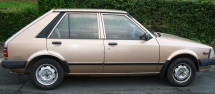
As the proud owner of the 24-year-old Thriftymobile (above), I was naturally interested – nay, excited – when the UK Government announced a “cash-for-scrap” car scheme in the recent Budget. The scheme aims to plump up the wilting auto sales industry; in a nutshell, cars aged 10 years or more can be traded in by their owners, who will then receive a £2,000 discount off the price of a new car. Of that sum, £1,000 is contributed by the government; the other £1,000 is contributed by the car company.
Much as I love the Thriftymobile, a £2,000 discount is not to be sniffed at. However, the first seeds of doubt were sowed in my mind when car ads began appearing in the newspapers, touting the new initiative.
These were illustrated with old bangers in crushed, compacted form. It made me feel slightly uneasy. The Thriftymobile is in fine fettle: despite it runs beautifully and, with the exception of the buffeted trunk, it looks pretty pristine. I’m not sure I want to think about my nice little car being smashed up into a metal cuboid! Rather like a Victorian parent, hoodwinked into dispatching my child to an unscrupulous “baby farmer“, I’d prefer to maintain the veneer of the idea that my beloved family member was going to a “good home”.
Now I’ve been reading more about the scheme on the Parker car guide site, I know it’s not a winner for me. Here are the reasons:
ONE: Car list prices are shooting upwards. They have risen by up to 8.5 per cent since the beginning of this year, thus reducing the value of the discount.
TWO: Manufacturers don’t have to provide this discount. They get to decide whether or not they are going to opt into this scheme. Some manufacturers, like Toyota, are choosing to apply this discount to mid-range models, but opting out when it comes to cheaper, greener models. So unless you’re after a large, more expensive car, this scheme may not be all it was cracked it up to be.
THREE: It appears that you only get the £2,000 discount off the list price – meaning that you aren’t eligible for any of the dealer’s other deals and initiatives. As one Parker’s commenter notes:
I have an 11 year old car that qualifies under the scheme but when I looked into it there is very little to be saved. E.G. I’ve just been quoted £6,500 for a brand new main dealer Peugeot 107. So with scrappage I’m thinking I’ll get £2000 off that price, making it £4,500. But no. They’ll only give me £2000 off the list OTR price so I’d end up saving only a few hundred pounds better than the £6,500 above. So if I take up the scrappage scheme the dealers simply pocket the saving.
Actually, the commenters aren’t impressed on the whole:
Yet another big CON!! I have just been to 4 dealers to enquire about a small economical car. Various discounts on offer, THEN, I say, “Now, what is the price with the car scrappage scheme?”. All stated no difference!! we already gave the £1000 discount, fair enough, so I stated but the government is giving you £1000 as well, so you are telling me that you are going to pocket the extra £1000 pounds without passing on any of it to me, so where is the incentive for me to buy?
FOUR: Car supermarkets, which sell cut-price vehicles, are not covered by this scheme.
FIVE: I’m not sure if the Thriftymobile would even be eligible! It fulfils all the criteria, such as having a current tax disc and MOT. However, I read somewhere that “insurance write-offs” are ineligible. After somebody drove into the rear of my car at a roundabout, the party-at-fault’s insurer refused to repair the damage because they said that it was too expensive. Instead they “wrote the car off” and gave me a couple of hundred quid instead. I’ve been driving the car around ever since, but presumably it is still technically a write-off?
SIX: And now I think about it in the cold light of day, with my sane head on, who would scrap the Thriftymobile? There isn’t anything wrong with it and it isn’t as if I could afford – or rather, would thoil – to pay cash for a spanking new car. (I don’t borrow against depreciating assets, so I wouldn’t take out a car loan.) It’s lasted longer than any car rolling off the production line in 2009 can be expected to last. Why exchange it for something with built-in obsolescence?
Here is another point to bear in mind, if you are going to be shopping around for a used car in the next year or so. Used car prices are also escalating – after all, 10-year-old models are worth £2,000 now! – and are expected to do so until the scheme expires in 2010.
Hmm, sounds like a lose-lose all round.
5 Responses to “Cash-for-scrap cars: don’t bother”
Mhi says:
The only benefitees (is that a word?) from this scheme that I can see are:
1) car manufacturers;
2) reasonably well-off people who can afford brand-new cars anyway.
I can’t see an environmental benefit – the energy amount associated with production of a new car means buying one is environmentally suspect.
Far better would be a grant to scrap any car and invest in a bicycle/bus & train tickets. Even buying a new motorbike would be an improvement!
May 12, 2009 at 1:14 pm
Zath says:
I’m quite happy with my car, a 6 year old Ford Focus (fully paid off), even if it was eligible I wouldn’t be interested in spending money on a depreciating asset in the current economic climate, but isn’t it nice to see the government encouraging everyone to do just that! – Not exactly the best use of money in these times im my opinion!
As soon as I heard about this scheme, I assumed they’d be loopholes and would exclude any other discounts to the point where it’s next to worthless.
Interestingly though, I did get a letter the other week from my Ford dealer asking if they could buy back my Focus model as it was in “high demand” – no idea what that’s all about!
May 19, 2009 at 1:05 pm
admin says:
@Zath How odd! Perhaps they want to purge the roads of older cars, so that we all have to buy the expensive new models? I can’t fathom it.
– Miss T.
May 19, 2009 at 11:44 pm
tuhin005 says:
Many of the local towing companies render free towing services to clients and contact the clients to collect their cars from homes without any possible additional expenses. Some companies accept all kinds of cars and models numbers and give you the best cash in exchange.
June 6, 2012 at 10:23 pm
Mim Jaba says:
Unlike most Scrap Car Removal companies which most of their revenue come from towing service not from junk car removal service,our service is exclusively in scrap car removal business, and we don’t do public towing. This exclusiveness makes us so dedicated to our scrap car removal obligations. Thats why We value our clients so much.
June 16, 2013 at 10:18 pm